One State, Two Banners: What the Michigan–Michigan State Rivalry Should Teach Lansing About Governing
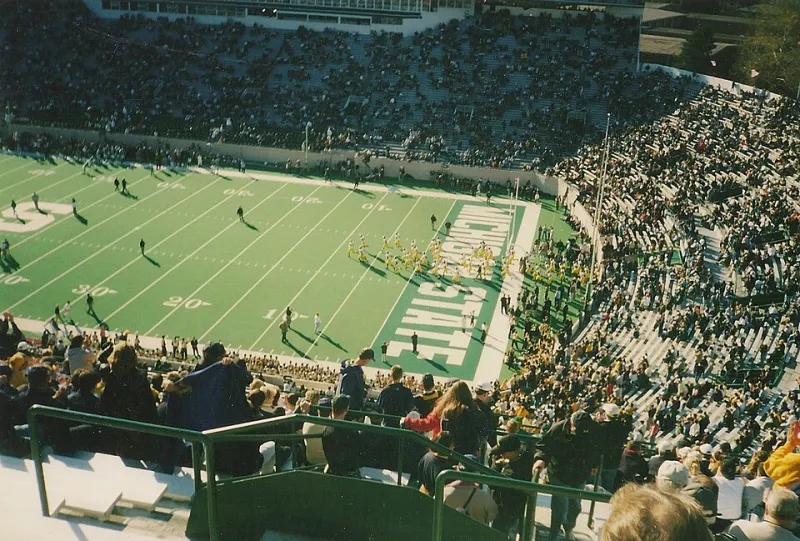
Photo: Michael Barera, CC BY-SA 4.0, via Wikimedia Commons
On the last Saturday of every October, this state performs a miracle that Lansing has never managed to replicate. Neighbors who agree on nothing else — on taxes, on schools, on the future of the towns they call home — sit in the same living rooms, wear their colors proudly, and argue with a passion that never curdles into permanent contempt. By Sunday, the loser hangs the flag back in the garage, and the winner lets it go by Tuesday. The state reunites.
Then the Legislature goes back into session, and the miracle ends.
The Divide We Cheer On Saturdays and Live With on Mondays
Michigan-Michigan State weekend is more than a football game. It is the one day a year when our deepest geographic and cultural fault lines are put on full display — and somehow made to feel like family business rather than enemy territory. The divide is real. The urban core of southeast Michigan and the small towns of the Thumb and the northern Lower Peninsula often feel like they are living in two different states. Rural Michigan watches its young people leave for the cities it cannot afford to visit. Urban Michigan struggles to understand why a grain elevator or a county road matters as much as a bus line or a community health center.
Lansing has a choice about what to do with that divide. Too often, it chooses to widen it. Districts are drawn and messages are crafted to reward grievance. Campaigns are won by convincing one Michigan that the other is the problem. And the people caught in between — the small manufacturer in Muskegon, the nurse commuting from Flint, the farmer in Cass County — are treated as spectators to a game they never agreed to play.
Being a Fan of the Whole Roster
Here is the standard I hold myself to, and the standard I ask every candidate for state office to accept: you must be a fan of all 83 counties, not just the one that elected you.
That is not a platitude. It is a governing philosophy with consequences. It means a representative from Grand Rapids should be able to explain, in honest detail, why a broadband line in the UP matters to the medical practices of Grand Rapids. It means a legislator from Detroit should be able to defend investment in a rural hospital or a county fairground as a matter of statewide interest — because it is. Michigan succeeds or fails as a whole. A state where the regions are thriving separately is a state that is quietly coming apart.
The rivalry gives us the model. Michigan and Michigan State fans do not pretend the other side does not exist. They engage, they compete, they keep score — and then they go back to being citizens of the same state. What they do not do is move out, stop talking, or declare the other side illegitimate. Imagine if Lansing operated that way.
Three Commitments to Bridge the Map
If we take that philosophy seriously, it leads to concrete policy. Three commitments:
First, a regional equity audit for every major bill. Before legislation leaves committee, it should come with a plain-language accounting of how it affects each region of the state — not just the population centers. If a bill quietly shifts costs onto rural townships or starves a metro transit system, every legislator should have to vote knowing it.
Second, a rotating capital calendar. Lansing should not have a monopoly on the business of Michigan. Major committee hearings on issues affecting agriculture, natural resources, and northern infrastructure should travel — held in Saginaw, Marquette, Battle Creek, and Sault Ste. Marie — so that the people who live with the consequences can testify without a four-hour drive.
Third, an urban-rural exchange corps for local leaders. Pair township supervisors with city council members from opposite ends of the state for a year of structured collaboration on shared problems: broadband, water infrastructure, workforce housing. The divides narrow fastest when the people solving problems have actually stood in each other's streets.
The Saturday Standard
None of this will erase honest disagreement. Michigan should argue with itself — argument is how a state figures out what it believes. The test is whether we argue the way families argue at a tailgate, or the way strangers argue in a comment section.
I believe Michigan is closer than our politics suggests. I have stood in stadiums and grange halls and union halls in every corner of this state, and I can tell you the things people care about sound remarkably similar everywhere: a fair shot for their kids, a road that doesn't wreck their truck, a future that doesn't require leaving. The rivalry divides us on Saturdays for fun. Lansing divides us the rest of the week for profit. It is time we elected people who treat the whole state like their team — because it is.
One state. Two banners. One future. Let's govern like it.