Seven Degrees in Sault Ste. Marie: The Test Lansing Never Runs
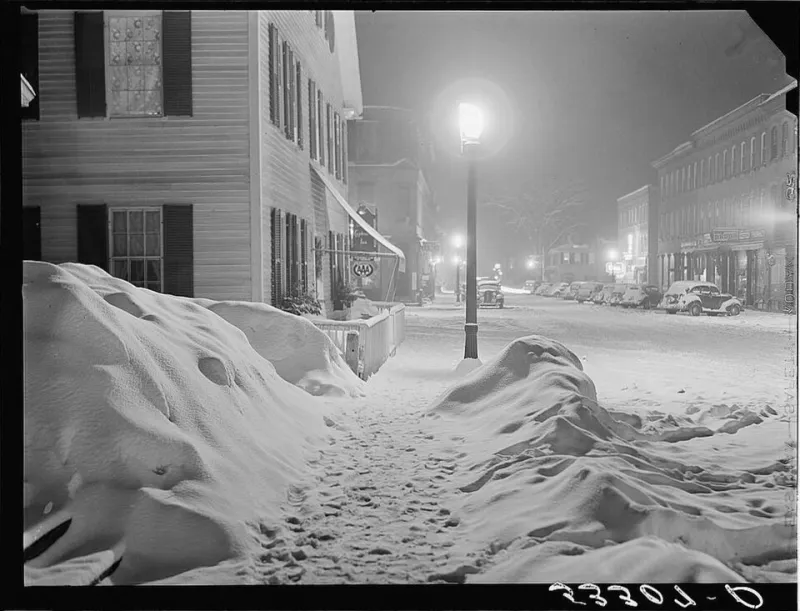
Photo: Marion Post Wolcott, Public domain, via Wikimedia Commons
There is a moment every January when the Eastern Upper Peninsula stops being an abstraction and becomes a fact of physics. The temperature drops to seven degrees and keeps falling. Wind off the river cuts through a car door seal like it isn't there. The school bus still runs, because it has to. The furnace still burns, because it must. And a family in Sault Ste. Marie goes about the business of getting through the week — the same week that a bill signed into law in Lansing was supposed to make a little easier.
That family is the reason I believe every piece of legislation that reaches the Governor's desk should face a simple test before it advances: would this policy still work for a household in Sault Ste. Marie during a weeklong deep freeze? Not in theory. Not on a spreadsheet. In practice, at seven below, with a plugged-in car block heater and a propane bill that arrives like a second mortgage.
The View From a Warm Office
Most legislation in Michigan is drafted in comfortable rooms. The offices are heated. The parking is nearby. The commute is measured in minutes, not hours across two peninsulas. That is not an accusation — it is a description of how institutions work. But it means the people writing our laws are, by default, writing them for the circumstances they know.
The consequences show up in the details. A rural development grant structured around broadband applications assumes broadband exists. An energy assistance program with a single in-person intake office assumes a family can get there. A transit pilot built around a nine-to-five schedule assumes the shift worker in the Soo — or Calumet, or Ontonagon — clocks out when the state does. None of these assumptions are malicious. All of them are expensive for the people they fail.
I have sat at kitchen tables in the U.P. where a family walked me through exactly how a well-intentioned state program broke down for them. The forms were fine. the eligibility was fine. The office was 90 miles away, and the last appointment of the day was before the second shift started. Policy does not fail loudly. It fails quietly, in the gap between what Lansing assumed and what January demanded.
A Regional Impact Review, Before the Vote
Here is the proposal I am putting forward as part of the Families First agenda: before any substantive bill advances out of committee, the Legislature should produce a short, plain-language regional impact review — a one-page accounting of how the bill affects communities outside the southeast and west Michigan population centers.
How does it play in a county with fewer than 10 people per square mile? What does it mean for a district where the nearest state office is a two-hour drive? Does a fee, a deadline, a paperwork requirement, or a service model hold up when the nearest grocery store is 40 minutes and the nearest DMV is further? If the answer to the January question is "we didn't check," the bill isn't ready.
This is not a new layer of bureaucracy for its own sake. It is the same discipline a good engineer applies before shipping a bridge design: test it under the worst conditions, not the average ones. January in the U.P. is Michigan's worst condition. If a policy survives it, it will almost certainly work in Warren and Wyoming. If it can't, better to learn that in a committee hearing than in a family's heating bill.
What the Test Would Have Caught
Run the test backward and the pattern is unmistakable. The unemployment system that buckled under pandemic demand was designed for claimants with reliable internet and flexible hours — not for a logger whose connection drops every time it snows. School snow-day policies written without accounting for rural bus routes turned a weather event into a childcare crisis for parents an hour from anywhere. Utility shutoff protections that look generous on paper still leave families in propane country exposed, because delivered fuel is regulated differently than the natural gas the rules were written around.
Each of these was fixable at the drafting stage. None of them was fixed, because nobody in the room was obliged to ask the question.
Governing for the Whole Map
I have said many times on this campaign that Michigan's future depends on whether the next generation believes the whole state belongs to them — not just the zip codes along the expressways. A regional impact review is how a Legislature proves it believes that too. It costs a page of paper. It saves families in Houghton, Hillman, and Hancock from paying for our blind spots.
So here is the standard I will hold myself to, and the one I will ask my colleagues to adopt: write the bill, then imagine the worst week of winter in the coldest corner of the state, and ask whether it still works. If it does, pass it with confidence. If it doesn't, we have more work to do — because the family in Sault Ste. Marie isn't an edge case. She's the point.