Who Can Afford to Be Heard? The Case for Family-First Public Meetings in Michigan
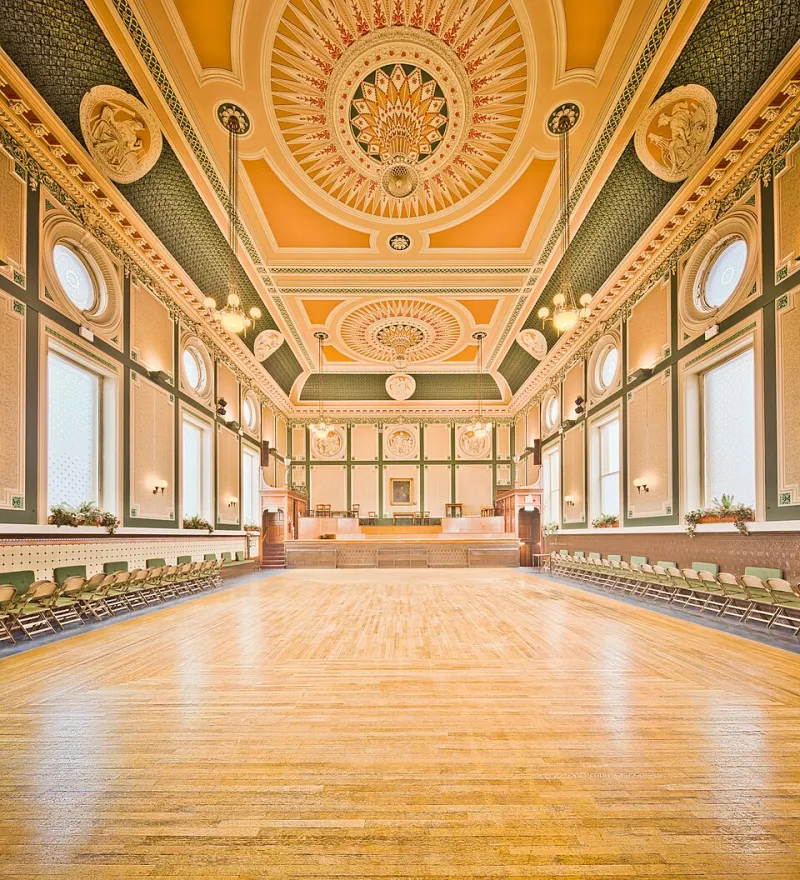
Photo: Michael D Beckwith, CC0, via Wikimedia Commons
There is a particular kind of quiet in a municipal meeting room at ten minutes past six. A few retired residents in the front row. A developer's attorney with a folder. Two council members who came straight from work. And an agenda item that will decide, for the next thirty years, what happens to a stretch of road that a thousand families drive every morning.
Meanwhile, in the parking lot of a daycare across town, a parent is doing arithmetic. The meeting starts at six. Pickup is at 5:45. The drive is eighteen minutes with traffic. There is no public comment until agenda item seven.
That parent is not disengaged. She is priced out.
The Meeting That Was Designed for Someone Else
Most of Michigan's public bodies inherited their meeting times from an era with a very different labor market — one with a single earner, a shorter commute, and a presumption that civic life happened in the evening while someone else managed the household. We have changed almost everything about how families work since then. We have changed almost nothing about how government meets them.
Consider what a working parent actually has to assemble in order to testify before a local board or a legislative committee. Time off work, or a shift swap, or an unpaid hour. Childcare, at a cost that frequently exceeds the value of the hour itself. Transportation, and parking, and a building that may or may not be on a bus line. Familiarity with a procedure nobody explained. And the composure to speak for three minutes in a room where the person who disagrees with you has brought a lawyer.
Any one of those is surmountable. Together they form a filter, and the filter selects for a very particular kind of participant. Not the most affected. The most available.
Three Barriers Nobody Designed on Purpose
The clock. Six o'clock is the worst hour of the day for households with young children. It is dinner, bath, homework, and the last fragile half hour before bedtime. Hearings scheduled at midday are worse for hourly workers, who cannot step out at all. A single fixed time will always exclude someone.
The room. Remote participation expanded dramatically and then quietly receded, and in many bodies it has been rolled back to a token viewing option rather than genuine two-way participation. Watching a livestream is not the same as being able to speak into the record.
The paperwork. Agendas and supporting documents posted the day before a meeting, in language written for people who already know the file, guarantee that only insiders arrive prepared. Public comment that is heard before the public has had a chance to read anything is comment in name only.
A Family-First Public Comment Standard
None of this requires a new appropriation or a constitutional amendment. It requires a standard — and I would propose five parts.
Publish early. Agendas, documents, and plain-language summaries no fewer than seventy-two hours before a meeting, with a one-page explanation of what the body is actually deciding and who is affected.
Meet people where they are. Every public body should offer genuine hybrid participation: the ability to speak, not merely to watch, with remote speakers called in the same order as those in the room and their testimony entered into the record identically.
Rotate the clock. No single hour serves every household. A rotating schedule that includes at least one evening meeting and one accessible daytime meeting per quarter spreads the burden across working parents, shift workers, and older residents instead of permanently favoring one group.
Welcome children. A small supervised space at the back of the room, stocked with books and crayons, removes an obstacle that costs almost nothing to remove. It also sends a message that a parent testifying with a child on her hip is a participant, not an interruption.
Accept written testimony as testimony. Comments submitted in writing, with the same weight and the same publication as spoken remarks, allow the parent who cannot leave the house and the nurse finishing a twelve-hour shift to be part of the record.
What It Costs to Do Nothing
The arithmetic runs the other way, too. Every decision made in a room that excludes the people most affected by it tends to produce a result that the public then resists, litigates, or quietly ignores. Civic trust is not built by proclamation. It is built by whether a person who shows up at a meeting feels that showing up was worth the cost.
We talk often about voter turnout. We talk far less about participation in the ordinary meetings where zoning, budgets, school closures, and water rates are actually decided. Those are the rooms where the shape of a neighborhood is set, long before anything reaches a ballot.
A Seat at the Table Means a Seat at a Time You Can Reach
The Families First Agenda is, at its core, a promise that state government will close the distance between Lansing and your street. That distance is not only measured in miles. It is measured in the hour a meeting begins, in whether the agenda was posted in time to read it, and in whether a parent can bring a child into a public building without feeling like a problem to be managed.
Open government is not a formality to be satisfied. It is a standard to be met — and it is well within our reach.