Fix the Fundamentals: K. Henry's Commitments on Roads, the Grid, and Your Property Tax Bill
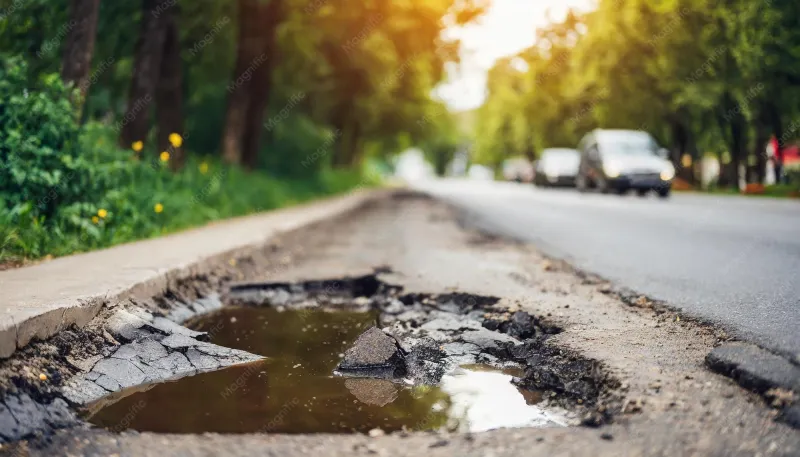
Photo: cracked asphalt pothole on Michigan residential street with houses in background, via img.freepik.com
Knock on enough doors in this state and a pattern emerges. Voters rarely open with the latest headline out of Washington. They open with the crack running through their driveway, the outage that spoiled a freezer full of food, or the assessment notice that arrived the same month their hours got cut.
We've come to call these the Three P's: potholes, power outages, and property taxes. They are unglamorous. They are stubbornly local. And they are, in our view, the truest test of whether state government is actually working for Michigan families.
The First P: Roads Built to Last, Not Roads Built to Reappear
On a canvass through Bay County last spring, a retired autoworker pointed to the end of his street, where a patch job from two years prior had already unraveled into a fresh crater. "They fix it just enough to get through the next election," he told us. He wasn't wrong — and he wasn't being partisan. He was describing a maintenance philosophy that has hollowed out road budgets for decades.
The Families First agenda rejects the band-aid model. Our commitments:
- Weight the funding formula toward durability. Direct a larger share of road dollars to reconstruction and preventive resurfacing rather than repeated spot patching, prioritizing local roads — the ones school buses and delivery trucks actually use.
- Guarantee local control with accountability. Require published, county-by-county dashboards showing where every road dollar goes and what condition rating each project targets, so residents can hold their governments to the results.
- Support Michigan workers and materials. Tie contract preferences to in-state hiring and Michigan-sourced aggregates and asphalt, keeping road money circulating in Michigan paychecks.
The Second P: A Grid That Doesn't Quit When the Weather Doesn't Cooperate
In the Upper Peninsula, an ice storm in April left a family we met without power for six days. They ran a generator they couldn't really afford, lost hundreds of dollars in food, and watched a sump pump fail in a flooded basement. Multiply that story by thousands of households, and you begin to understand why grid reliability isn't an abstract utility debate — it's a family-finance crisis.
Michigan's outage times have consistently ranked among the worst in the nation, and the burden falls hardest on rural residents, seniors on fixed incomes, and families who can't absorb the cost of spoiled groceries or lost wages. Our commitments:
- Hold utilities to real reliability standards with meaningful penalties for chronic outages, and require transparent reporting of outage frequency and duration by ZIP code — because accountability starts with visibility.
- Invest in grid hardening and undergrounding in high-risk corridors, prioritizing areas with repeated outages rather than the easiest engineering wins.
- Expand credits and rebates for customers who bear the cost of outages, including food-spoilage reimbursement that is actually easy to claim, and weatherization support that lowers bills while reducing demand on the system.
- Grow Michigan energy jobs by pairing reliability investments with training pipelines for lineworkers, grid technicians, and clean-energy installers across community colleges and union halls.
The Third P: Property Taxes That Stop Outrunning Paychecks
Perhaps nothing captures the squeeze on Michigan families quite like the property tax bill. On a porch in Kentwood, a schoolteacher showed us her assessment alongside her last three years of pay stubs. The assessment climbed steadily. The stubs did not. "We're not asking for a mansion," she said. "We're asking to stay in the one we have."
Rising housing values are good news on paper and punishing news in practice for anyone on a fixed income. Our commitments:
- Cap assessment growth more tightly for seniors and disabled homeowners, so no Michigander is taxed out of the home they've spent a lifetime paying for.
- Expand and simplify the Homestead Property Tax Credit, raising income eligibility thresholds and streamlining the application so working families actually claim what they're owed.
- Audit state-imposed mandates on local governments and fund them properly, so municipalities aren't forced to raise local levies to cover obligations Lansing passed down without paying for.
- Protect Proposal A's core promise while examining modern exemptions that no longer serve their original purpose, directing any recovered revenue toward school funding and local services.
Why the Small Stuff Is the Big Stuff
There's a temptation in politics to chase the dramatic and the distant. But families don't experience government through press conferences. They experience it through the shock absorbers they replace, the generator they rent, and the tax bill taped to the refrigerator.
The Three P's won't make headlines across the country. They will make a difference in every county in Michigan. And that, at the kitchen table where real decisions get made, is exactly the kind of politics we believe in.