Under the Friday Lights: How the Concessions Stand Trains Michigan's Next Leaders
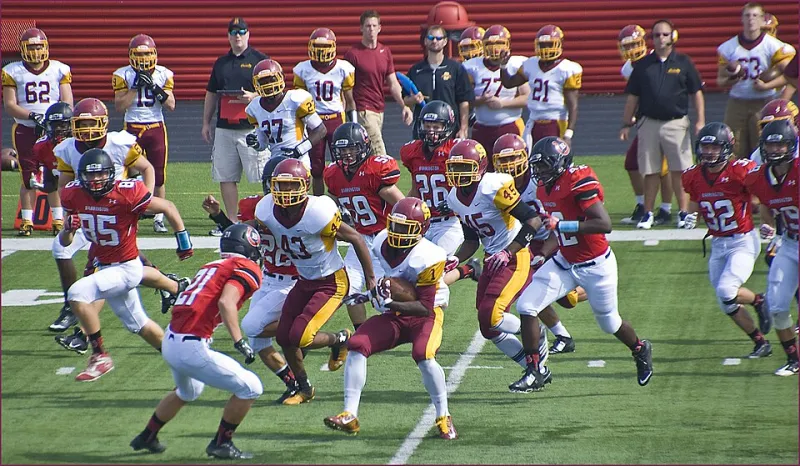
Photo: Ron Cogswell, CC BY 2.0, via Wikimedia Commons
Where Civic Life Actually Starts
Spend a Friday evening this fall at a Michigan high school football stadium — in Muskegon, in Saline, in Sault Ste. Marie — and you will learn more about the health of a community than any spreadsheet can tell you. Look past the scoreboard. Watch who is working the gate, who restocked the hot dog rollers at halftime, who is quietly tracking the budget for new bleacher repairs on a clipboard worn soft at the edges.
These are not small jobs. They are the unpaid apprenticeship of self-government.
The conventional wisdom says political careers begin with law school or a party endorsement. I would offer a different observation, drawn from two years of listening tours across this state: most of the people who eventually run for school board, township trustee, or the state House first learned how to organize around a booster club table, arguing about fundraiser schedules and field maintenance under fluorescent gym lighting.
The Volunteer Ledger
Consider what a concessions stand actually requires. Inventory management. Cash handling. Volunteer scheduling. Dispute resolution when two parent groups both claim the same Friday night. It is a small enterprise with real stakes — the proceeds often fund uniforms, band instruments, and senior scholarships — and it runs on people who have full-time jobs and still show up.
In community after community, I met the same archetype: the person who started by donating a case of pop and ended up chairing the entire athletic booster association. Ask them why, and they rarely talk about politics. They talk about their kids, their neighbors, and a stubborn belief that if they don't do it, nobody will.
That instinct — if not me, then who? — is the raw material of democratic leadership. The question is whether we recognize it, recruit it, and build a pipeline from the bleachers to the ballot.
Who Shows Up Tells You Who's Running Things
There is a harder truth hiding in those stands, too. Look around on any given Friday night and ask who is doing the work. In too many Michigan towns, the same dozen faces carry the load year after year — and increasingly, those faces skew older, wealthier, and more connected than the community they serve.
Working parents pulling double shifts cannot staff a concession window. Families new to the country are rarely asked. When the volunteer base narrows, so does the eventual candidate pool, and the decisions made in Lansing drift further from the lived reality of most Michiganders.
This is not a complaint about the people who show up. It is a warning about the systems that keep others from doing so. If we want a Legislature that reflects the state — more nurses, more tradespeople, more parents juggling childcare — we have to make the first rung of civic participation accessible. That means flex volunteering, childcare at booster meetings, and a culture that treats a two-hour shift as a genuine contribution rather than a lifetime commitment.
From the Bleachers to the Ballot
I have profiled dozens of Michiganders on this journey. A Flint machine operator who ran the touchdown club and now sits on her county commission. A Marquette mom who organized concession rotations for three seasons and decided the school board needed her practical streak. A Westland plumber who fixed the stadium's broken plumbing for free, got curious about the district's maintenance budget, and is now challenging an incumbent for a seat nobody thought was winnable.
None of them waited for permission. None of them had a political pedigree. What they had was credibility earned the old way — by showing up when it counted and asking nothing in return.
That is the model I want to elevate. If you have ever balanced a booster budget, you can read a state budget. If you have ever organized a volunteer schedule, you can organize a campaign. If you have stood in the rain selling tickets at the gate, you understand public service better than most people who hold office.
A Challenge for This Season
So here is my ask, and it is not a small one. This fall, when you attend a game — and you should, because nothing in Michigan beats October football under the lights — do more than watch. Introduce yourself to the people running the stand. Ask what they need. Offer one shift. And when the season ends, ask yourself the question every strong community eventually poses to its residents: what is the next thing you could do for the place you live?
Because the Friday Night Test is not really about football. It is about whether Michigan's communities still produce citizens willing to carry responsibility without applause. The stadiums tell us the answer is yes — if we make room for everyone who wants a turn.
The pipeline to a better Lansing does not start in a Capitol rotunda. It starts at the bleachers, one hot dog and one volunteer shift at a time. Let's build from there.